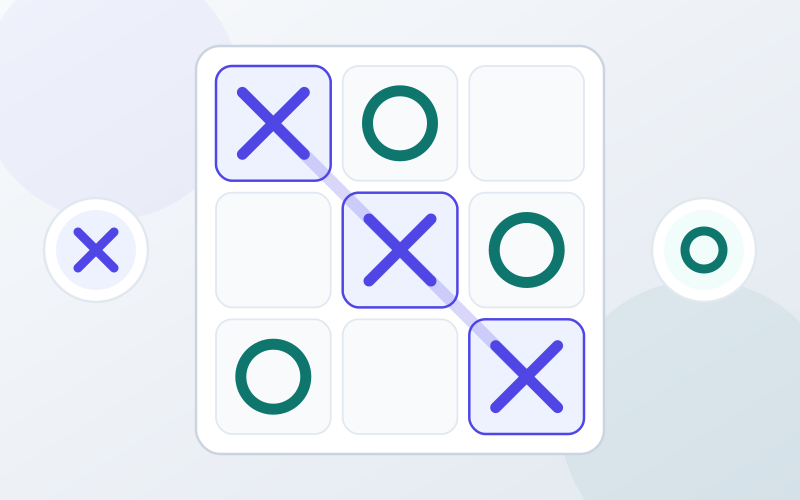
Why Classic 3×3 Tic Tac Toe Ends in a Draw (And How to Break It)
Tic Tac Toe (also called Noughts and Crosses) has only 255,168 possible games—and mathematically, when both X and O play without mistakes, every classic 3×3 round ends in a tie. That is why our browser board gives you two things at once: an exact Minimax Impossible AI to test whether your classic defense is truly airtight, plus instant one-click switching into 5 deeper modes when you want decisive wins instead of stalemates.
Pick Your Tic Tac Toe Mode by Break Length
| Available Time | Recommended Mode | What Changes |
|---|---|---|
| 1–2 minutes | Classic 3×3 (this board) | Instant warm-up; test your opening theory against Easy, Medium, or Minimax AI. |
| 2–4 minutes | Infinite Tic Tac Toe | Max 3 marks each—your oldest mark disappears on turn 4, so every match produces a winner. |
| 3–5 minutes | 4x4 Tic Tac Toe | 16 squares, no single center cell, and 4-in-a-row geometry. |
| 4–7 minutes | 5x5 Tic Tac Toe | 28 winning lines where open-three forks decide the game. |
| 5–12 minutes | Ultimate Tic Tac Toe | Nine linked 3×3 boards where your cell choice dictates your opponent's next board. |
The 5-Step Priority Decision Tree (Never Lose Classic 3×3)
Instead of memorizing dozens of board diagrams, follow this exact priority order on every turn—it is the same logic behind our Minimax engine:
- Win immediately: If you already have two marks in a line and the third square is open, take it.
- Block immediately: If your opponent has two marks in a line, block the third square.
- Create a fork: Place a mark that creates two simultaneous 2-in-a-row threats.
- Block an opponent's fork: If X opens in opposite corners (
A1andC3) while you hold the center (B2), play an edge (A2,B1,B3, orC2)—never a corner. Playing a corner lets X force a guaranteed diagonal fork. - Claim high-value geometry: Prefer the center (part of 4 winning lines), then an opposite corner (3 lines), then an empty corner, and leave edges (2 lines) for last.
Playing First (X) vs. Playing Second (O)
Use the Play X / Play O dropdown in the toolbar to practice both sides of the board. Opening as X in a corner gives human opponents the highest rate of defensive blunders; switching to O against Impossible AI is the fastest way to verify that you truly understand fork prevention.