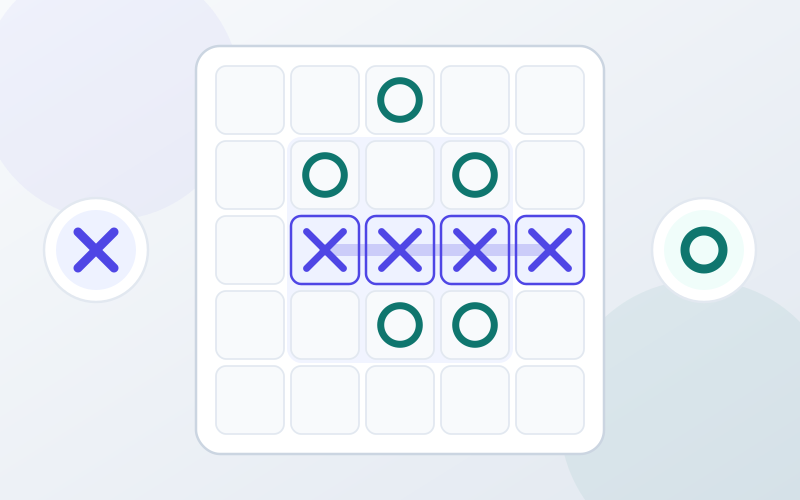
5×5 Tic Tac Toe (4 in a Row) vs. Gomoku: The Tactical Sweet Spot
Playing 4 in a row on a 5×5 grid bridges the gap between casual Tic Tac Toe and full Gomoku (Five in a Row). Jumping from 16 squares on 4x4 to 25 squares on 5×5 multiplies the number of winning lines from 10 to 28—and introduces open-three forks that make defense far more demanding.
| Feature | 4×4 Tic Tac Toe | 5×5 Tic Tac Toe (This Board) | Gomoku (9×9–15×15) |
|---|---|---|---|
| Win target | 4 in a row | 4 in a row | 5 in a row |
| Winning lines | 10 lines | 28 lines (incl. 4 off-center diagonals) | 192+ lines |
| True center cell | No (2×2 block) | Yes (C3) |
Yes |
| Unstoppable "Open Three" | Impossible | Yes (_ X X X _) |
Open Four (_ X X X X _) |
Tactical Pattern Atlas: 3 Winning Shapes to Spot
1. The Unstoppable Open Three (_ X X X _)
. X X X . <-- Both ends open: opponent can only block one side!
Whenever you land three marks in a row across the inner three squares of any row, column, or main diagonal with both ends empty, the game is already won. Defensively, you must break an opponent's open two (_ X X _) before it turns into an open three.
2. The L-Shape Double Two
.  .  .  .  .
.  X  X  .  .
.  X  .  .  .
.  .  .  .  .
Placing an intersecting horizontal and vertical pair inside the central 3×3 core forces your opponent to guess which direction to block, frequently handing you a free open three on the other axis.
3. The Off-Center Diagonal Sneak
Unlike 4×4, a 5×5 grid contains four 4-cell off-center diagonals parallel to the two main diagonals. Most players scan rows and main diagonals first—making off-center diagonal 4-in-a-row attacks the easiest trap to slip past human opponents in 2 Player mode.
Board Zones: The Core 3×3 vs. The Outer Ring
Think of the 5×5 board as two concentric zones:
- The Inner 3×3 Core (9 squares): Every open three must live here. Fight for the exact center (
C3) and its four diagonal neighbors early. - The Outer Ring (16 squares): Outer squares can only finish a 4-in-a-row line—they can never serve as the middle of an open three along their border. Use outer squares to cap off threats, not as your opening moves.