Decoding White & Black Kropki Dots
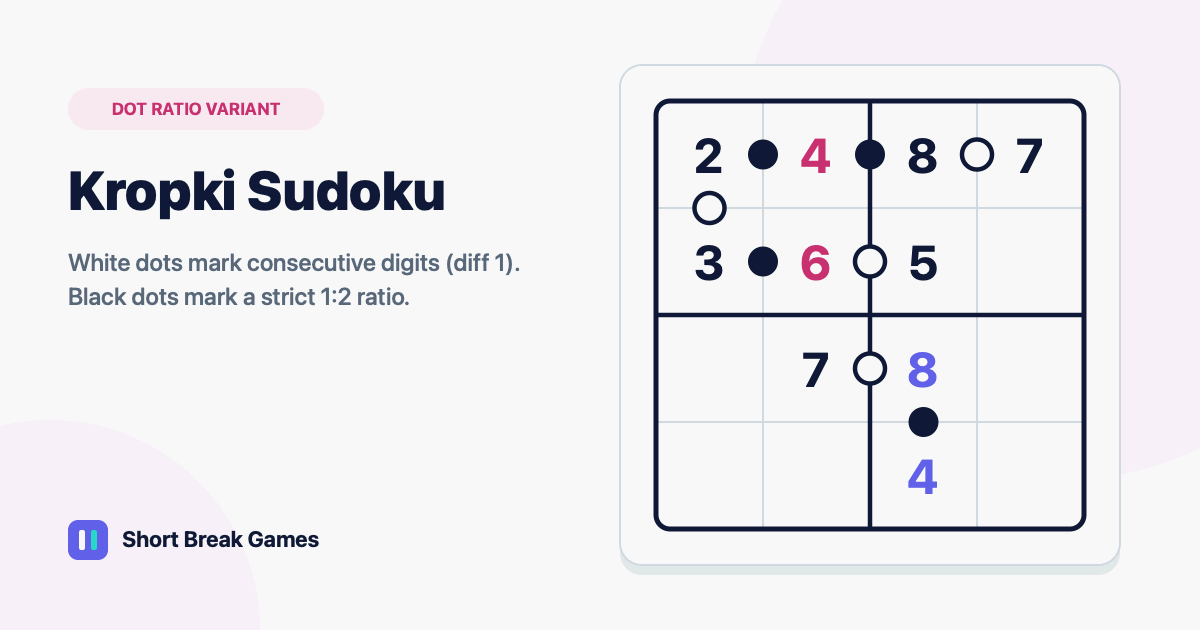
Kropki Sudoku places small dots directly on the border between orthogonally adjacent cells. Every visible dot enforces an exact pairwise relationship:
- White Dot (
○): The two touching cells are consecutive (difference of 1, such as3–4or8–9). - Black Dot (
●): One touching cell is double the other (1:2ratio).
(This edition uses partial Kropki rules: every shown dot must be obeyed, while unmarked borders have no extra restriction.)
The Black-Dot Power Map: {1,2,4,8} vs. {3,6}
The fastest Kropki breakthroughs come from recognizing that black dots split the digits 1–9 into three rigid groups:
| Digit Group | Behavior Next to a Black Dot (●) |
Immediate Deduction |
|---|---|---|
{5, 7, 9} |
Forbidden — can never touch any black dot | Scan black-dot-heavy boxes to place 5, 7, and 9 in dot-free cells first |
{3, 6} |
Isolated Pair — 3 only pairs with 6, and 6 only pairs with 3 |
A chain of 2 consecutive black dots (A ● B ● C) can never contain 3 or 6 |
{1, 2, 4, 8} |
Power-of-Two Chain (1–2–4–8) |
Any 3-cell black-dot chain (A ● B ● C) must be {1,2,4} or {2,4,8} with 2 or 4 in the middle |
Combining White & Black Dots in Chains
- The
1–2Overlap: The pair{1, 2}is the only pair in 1–9 that is both consecutive (white dot) and 1:2 ratio (black dot). - Alternating Chains (
○+●): When a single cell touches both a black dot and a white dot, test{1,2,3,4,6,8}against its consecutive neighbor—often collapsing a 3-cell cluster into a single forced triple.
Looking for more zero-addition modern logic? Pair Kropki with Thermo Sudoku, Jigsaw Sudoku, or browse all 6 modes on our Sudoku Variants Hub.