How Killer Cages Replace Starting Clues
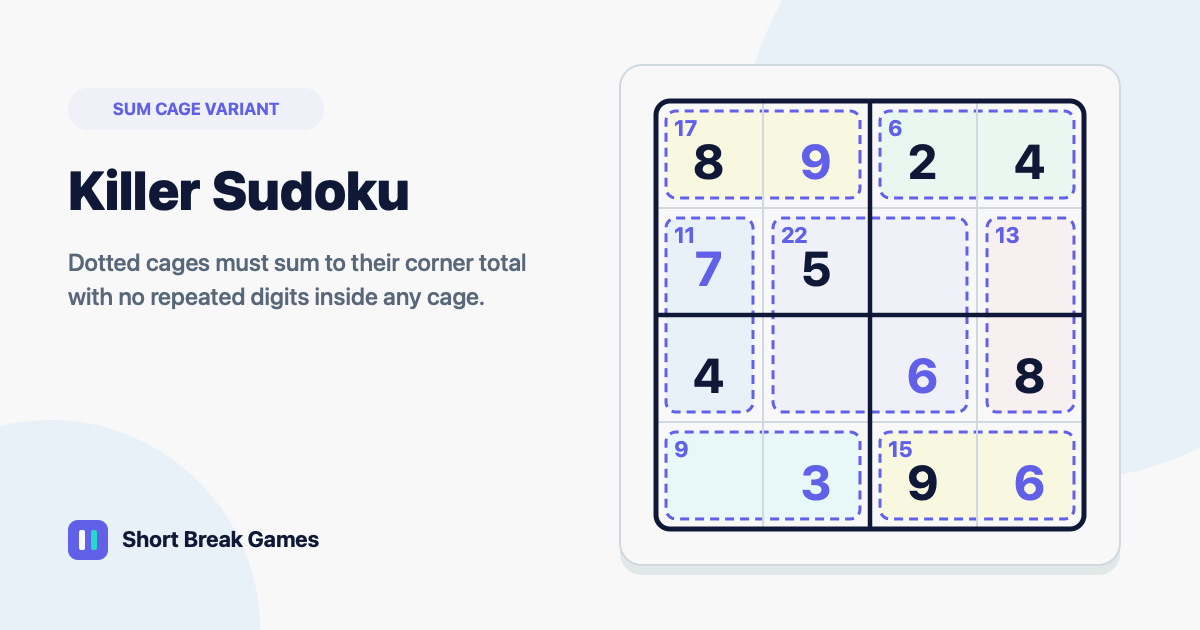
In Killer Sudoku, dotted cages group adjacent cells together and display a target sum in the top-left corner. Instead of giving you 25–35 starting digits, a Hard Killer grid can start completely empty—leaving every deduction to the interplay between non-repeating cage totals and standard 9×9 houses.
Click any cage on the board above to view its valid combinations in the side panel and cross off eliminated sets as you work. For multi-digit filtering across 2-to-9 cell cages, use our dedicated Killer Sudoku Combinations Calculator.
The Rule of 45: Innies and Outies
Every complete row, column, and 3×3 box sums to 45 (1+2+3+4+5+6+7+8+9). Comparing cage totals against 45 unlocks hidden single cells without guessing:
| Pattern | What You See in a 3×3 Box (or Row/Col) | Exact Formula |
|---|---|---|
| Single Innie | Full cages cover 8 cells of a box, leaving 1 cell uncovered | Innie = 45 − (Sum of enclosed cages) |
| Single Outie | Cages cover all 9 cells of a box plus 1 cell sticking outside | Outie = (Sum of cages) − 45 |
| Two-House Span (90) | Cages cover two full adjacent rows/columns except 1 cell | Missing Cell = 90 − (Sum of cages) |
| Cage Splitting | A 3-cell cage crosses a box border with 1 cell sticking out | Split the cage sum using the box's 45-total to isolate the protruding cell |
Must-Know Unique ("Magic") Cage Sums
Before scanning the whole grid, lock in cages that have only one possible combination of non-repeating digits:
- 2-cell cages:
3= {1,2} ·4= {1,3} ·16= {7,9} ·17= {8,9} - 3-cell cages:
6= {1,2,3} ·7= {1,2,4} ·23= {6,8,9} ·24= {7,8,9} - 4-cell cages:
10= {1,2,3,4} ·11= {1,2,3,5} ·29= {5,7,8,9} ·30= {6,7,8,9}
Once a unique cage sits inside a single 3×3 box, those exact digits are immediately eliminated from the rest of that box. Looking for a lighter sum-based variant? Try Arrow Sudoku or browse all 6 puzzles on the Sudoku Variants Hub.